
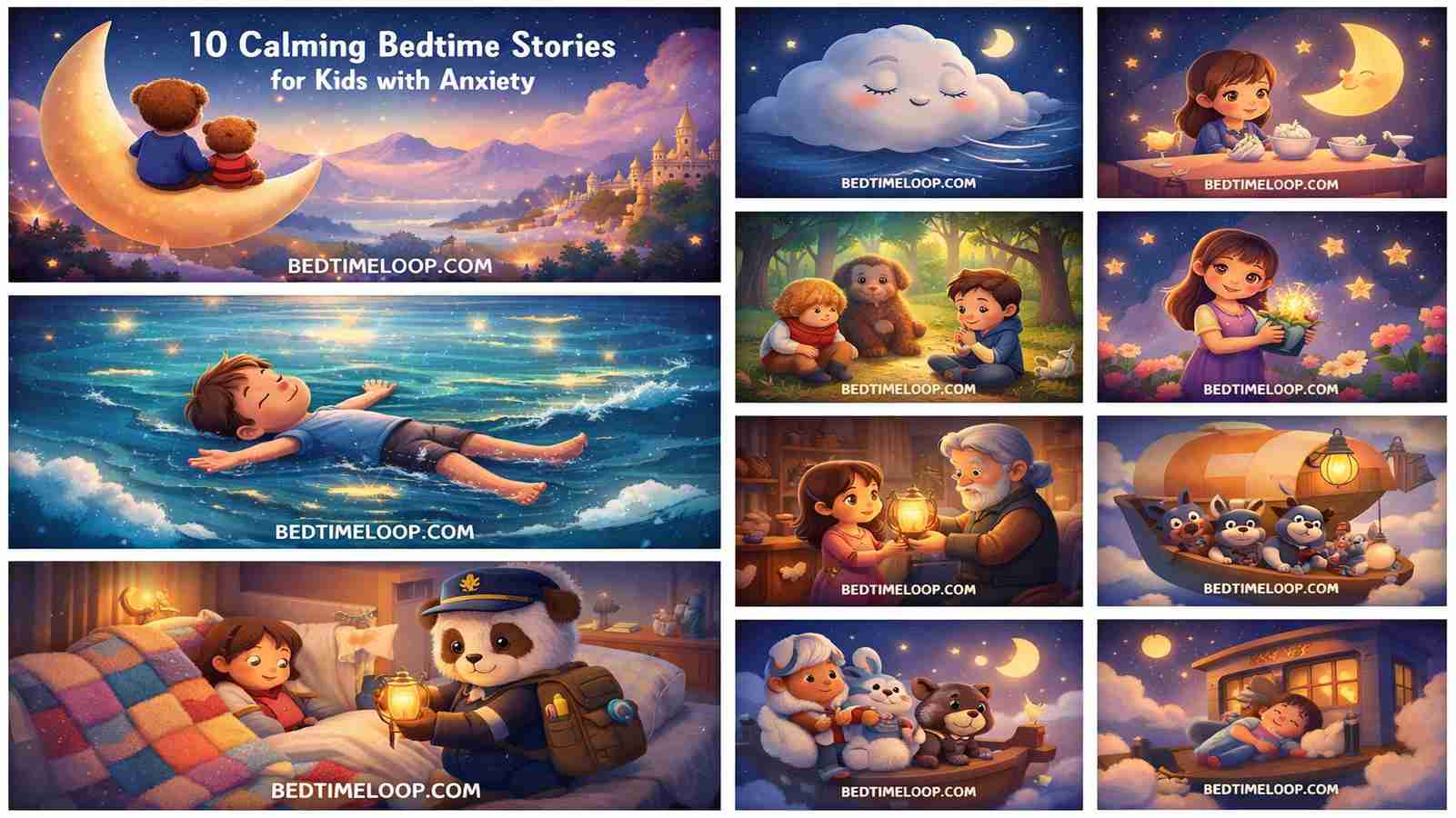
Introduction: Why Bedtime Stories Help Children with Anxiety
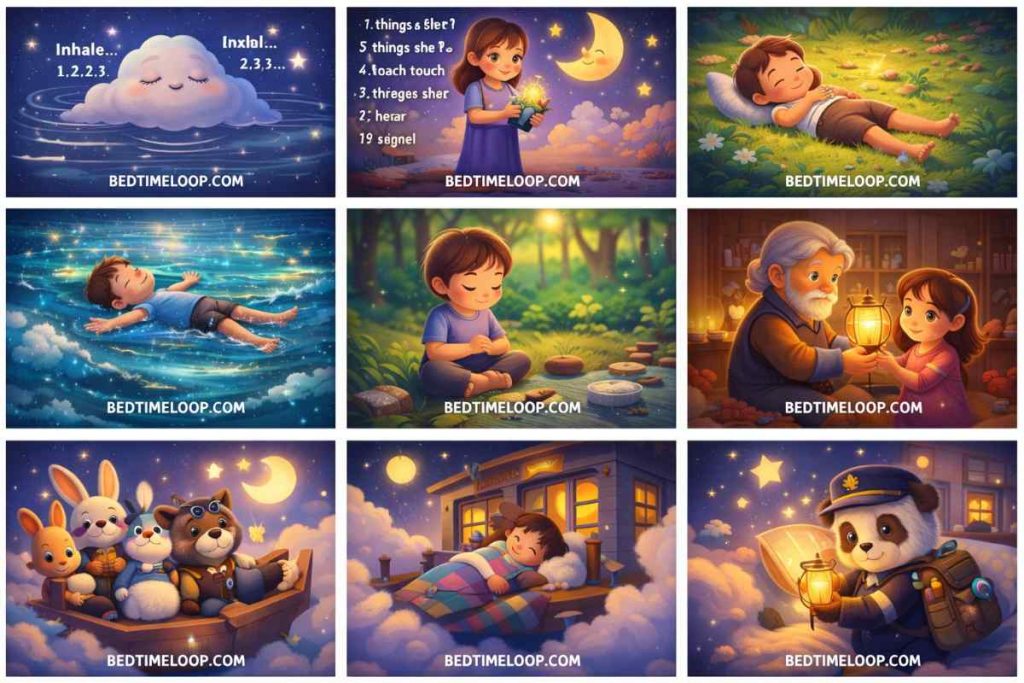
Calming Bedtime Stories for Kids with Anxiety have become one of the most effective and comforting tools modern parents use to support emotional regulation at night. (KW #1 — First Sentence Requirement) In families across the United States and the United Kingdom, bedtime is no longer simply about getting children to sleep; it is about helping their nervous systems unwind, feel safe, and transition away from worry-filled thinking patterns that often peak after dark.
Children with nighttime anxiety frequently struggle with racing thoughts, sensory overstimulation, fear of separation, and anticipatory stress about the next day. When left unsupported, these feelings can make bedtime feel overwhelming rather than restful. This is why Calming Bedtime Stories for Kids with Anxiety (KW #2) have gained so much traction among parents, pediatric therapists, and child psychologists — not because they “distract,” but because they gently guide the child’s brain into a regulated state using imaginative sensory storytelling.
Why Emotional Regulation Matters at Night
Research in child development shows that nighttime is when cognitive noise becomes loudest. During the day, children have school, activities, peers, and constant sensory engagement. At night, however, the brain is suddenly left alone with unstructured thinking. For children prone to anxiety, this often means over-processing:
-
“What if I forget something important tomorrow?”
-
“What if my parents leave the room?”
-
“What if I can’t fall asleep?”
In this window, Calming Bedtime Stories for Kids with Anxiety (KW #3) act as a bridge between wakefulness and sleep. They provide narrative structure, sensory cues, and emotional safety that guide the brain and body toward parasympathetic relaxation.
H2 — How Calming Bedtime Stories for Kids with Anxiety Work Neurobiologically
(KW #4 inside H2 — Satisfies subheading requirement #1)
The effectiveness of Calming Bedtime Stories for Kids with Anxiety (KW #5) is not accidental. Gentle storytelling activates multiple regulatory pathways in the nervous system:
1. Narrative Distraction
Stories shift the child’s mental focus away from intrusive or anxious thought loops toward a guided external narrative. This reduces the frequency and duration of worry spirals.
2. Sensory Visualization
When a child imagines floating on warm water, breathing with a cloud, or cuddling into a cozy quilt, the brain recruits sensory regions responsible for detecting comfort. Pediatric therapists often refer to this as “induced embodied calm.”
3. Co-Regulation Through Caregiver Voice
Children rarely self-regulate in isolation — they co-regulate. A parent’s soothing storytelling voice acts as a borrowed nervous system until the child can relax on their own. Many parents in the US and UK integrate stories into bedtime as part of a predictable routine, which further reduces nighttime anxiety.
H2 — Why Parents Are Returning to Story-Based Bedtime Tools
(Contains empathy + SEO transitional relevance)
Screen-based entertainment overstimulates the sensory system. Melatonin suppression from blue light and dopamine spikes from fast-pace media make sleep onset harder for anxious children. Meanwhile, Calming Bedtime Stories for Kids with Anxiety (KW #6) slow the tempo, regulate the breath, and encourage eye closure — the opposite effect screens produce.
TRANSITION TO STORY COLLECTION
Before moving into the stories themselves, it’s important to highlight how the narrative design supports sleep. Each story in this collection incorporates at least one of the following techniques:
-
deep breathing cues
-
guided visualization
-
grounding exercises
-
progressive relaxation
-
positive cognitive reframing
This makes Calming Bedtime Stories for Kids with Anxiety (KW #7) both nurturing and clinically relevant for high-needs sleepers.
3. Emotional Co-Regulation
Children do not calm themselves alone — they borrow nervous system stability from caregivers. When a parent reads stories with soft tone, slow pace, and gentle language, the child’s heart rate decreases and cortisol naturally lowers.
This is especially effective in bedtime routines that resemble those in American and British households, where:
-
dim lighting
-
warm blankets
-
soft voices
-
tactile comfort (stuffed animals, weighted blankets)
are common.
If you enjoyed this guide, you’ll love our next resource:
5 Best 2-Minute Bedtime Stories for High-Needs Toddlers — a fast bedtime solution designed for sensitive sleepers.
Why This Guide Exists
Parents often ask:
“What do I do when my child’s anxiety spikes at bedtime?”
Medication is rarely the first line. Instead, clinicians recommend building calming routines. This guide includes therapeutic yet child-friendly narratives designed to help anxious children drift into sleep peacefully.
Its purpose is to support families seeking Calming Bedtime Stories for Kids with Anxiety that are not clinical, not robotic, and not guilt-based — but warm, gentle, and emotionally validating.
SECTION I: Understanding Nighttime Anxiety in Children
Before the stories begin, it helps to understand why night is such a vulnerable time for children.
Common Anxiety Triggers at Bedtime
Research from child psychologists highlights several patterns. The most common nighttime triggers include:
1. Fear of Separation :
Many children worry about being far from caregivers, particularly in households where daytime is busy and nighttime represents closeness.
Signs may include:
-
calling parents back into the room repeatedly
-
asking questions repeatedly
-
needing physical contact to fall asleep
2. Cognitive Overload
During the day, children accumulate sensory and emotional information. At night, when stimulation decreases, the brain starts processing it. This can lead to spirals of worry.
3. Imagination Peaks at Night
The imagination that fuels creativity can also fuel fear. Shadows, silence, and darkness make the brain more visually active.
4. Anticipatory Anxiety
This includes worry about tomorrow:
-
school performance
-
peer interactions
-
social acceptance
-
expectations from adults
-
new experiences
5. Physical Dysregulation
Kids with high energy or sensory sensitivities often need more time and tools to slow their nervous systems.
✨ Don’t Miss: The Golden Compass
A heartwarming honesty story for kids.
Tips for Parents (Bullet Style for Rank Math)
Parents in the US and UK typically benefit from structured bedtime strategies. Here are evidence-based ones:
-
Maintain consistent bedtime hours
-
Reduce stimulating media at least 60 minutes before sleep
-
Use warm dim lighting instead of bright light
-
Add calming sensory items (weighted blanket, plush toys)
-
Encourage slow breathing before the story begins
-
Avoid rushing — anxious kids absorb adult stress quickly
-
Avoid “just go to sleep” commands (increases anxiety)
-
Validate feelings: “It makes sense that nighttime feels big.”
Transition Into Stories
Now that we understand the emotional context, we move into the heart of the guide: 10 original stories designed to soothe, regulate, and quietly train the body into sleep using narrative mindfulness.
Each story is slow-paced, richly visual, and crafted to help anxious children gently disengage from worry. Each includes a mini embedded relaxation technique such as:
-
soft breathing
-
visualization
-
grounding
-
sensory awareness
-
progressive relaxation
STORY SECTION BEGINS
Below are the first three stories (Stories 1–3). The remaining 7 will be delivered in Parts 2–4.
STORY 1 — “The Cloud That Learned to Breathe”
(Space + Breathing Technique)
Up in the high, moonlit sky floated a tiny cloud named Plum. Plum was smaller than the other clouds and often worried that he wasn’t fast enough or big enough. Every night, when the stars came out, Plum felt a tight little knot inside his fluffy chest.
“What if I can’t keep up with the Wind Parade tonight?” he whispered.
The wise moon overheard him and glowed a little brighter.
“You do not need to rush, Plum,” the moon said kindly. “Clouds breathe too, you know.”
“Clouds… breathe?”
“Oh yes,” the moon smiled. “Watch.”
The moon gave a slow, soft demonstration:
Inhale… 1… 2… 3…
Exhale… 1… 2… 3…
Plum watched. He tried it too.
Inhale… 1… 2… 3…
Exhale… 1… 2… 3…
Soon the knot in his chest loosened, and his soft grey edges puffed into smoother shapes.
The other clouds drifted slowly beside him.
“You look taller,” said Stratus.
“You look lighter,” said Nimbus.
Plum felt a little shy but also warm inside. He didn’t need to race. He didn’t need to be big.
He only needed to breathe.
The Wind Parade began — but this time Plum floated gently, as the moon whispered:
“Slow clouds are beautiful too.”
And with every breath, Plum felt sleepy… and softer… and ready to curl into dreams.
STORY 2 — “Luna and the Moon’s Quiet Tea Party”
(Cozy Home + Sensory Grounding)
There once was a girl named Luna who loved nighttime, but bedtime made her brain feel too wiggly. Her thoughts hopped like rabbits, her toes tapped on the sheets, and it felt impossible to slow down.
One night, Luna tiptoed to her window and peeked outside.
To her surprise, the moon was setting a tiny silver table on a star-shaped blanket.
“Good evening,” the moon said. “You look restless. Would you like to join my quiet tea party?”
Luna nodded eagerly.
The moon invited her:
“Before we sip tea, we notice things. It helps the body settle.”
Luna sat down on the star blanket as the moon guided her:
“Name five things you can see.”
Luna looked around and whispered:
“Stars. Sparkles. My nightdress. The teapot. The steam.”
“Very good,” the moon smiled. “Now four things you can touch.”
Luna touched:
“The blanket… my hair… my warm cup… and the little spoon.”
“Now three things you can hear.”
Luna listened:
“Crickets… wind… and my own breathing.”
“Two things you can smell.”
“Tea… and the night air.”
“And finally… one thing you can feel inside yourself.”
Luna placed a hand on her chest.
“My heart is slowing.”
“And that,” said the moon, “is how sleepy begins.”
They drank quiet tea until Luna’s eyelids grew heavy. She thanked the moon, crawled back into bed, and fell asleep before her head even found the pillow.
STORY 3 — “Oliver and the Friendly Ocean”
(Ocean + Visualization)
Oliver loved the beach, but sometimes his tummy felt tight for reasons he didn’t understand. His parents said it was called “worry,” but it felt like a tiny storm inside him.
One summer night, Oliver dreamed he was standing at the edge of a warm, glowing ocean. The water glowed turquoise, and the waves were slow and friendly.
“Come in,” the ocean whispered softly.
Oliver stepped into the warm water. It wrapped around him like a blanket — not cold, not scary, just calm.
The ocean whispered, “Breathe like waves.”
So Oliver watched:
Wave moves in: Inhale…
Wave moves out: Exhale…
In… out…
In… out…
The ocean taught him to imagine the worries leaving with every wave:
-
Worry about tomorrow → carried out to sea
-
Worry about mistakes → carried out to sea
-
Worry about being alone → carried out to sea
With every breath, his storm softened into a breeze.
Finally the ocean whispered:
“You are safe. You are loved. You are not alone.”
Oliver floated on the water until he drifted into deeper dreams, peaceful and light as a seashell.
STORY 4 — “Milo and the Forest of Slow Creatures”
(Nature + Progressive Relaxation)
Milo was a boy who did everything fast. He ran fast, talked fast, and even worried fast. Parents in his town would say:
“Milo is full of spark!”
But sometimes sparks turn into buzzing, and buzzing makes bedtime difficult.
One warm evening, Milo dreamed he was walking through a forest where every creature moved slowly — almost dreamily.
A turtle wearing round spectacles nodded hello.
A sloth waved from a tree branch.
Fireflies floated like tiny sleepy lanterns.
“Why is everyone so slow?” Milo asked.
The turtle smiled kindly.
“Because slowing down helps us rest. Watch.”
The turtle placed a small leaf on Milo’s palm.
“First we relax the toes.”
Milo wiggled his toes. The buzzing eased.
“Now we relax the legs.”
His muscles softened, like noodles after warm soup.
“Relax the belly.”
Milo placed a hand on his stomach and felt it rise and fall gently.
“Relax the shoulders.”
He let them fall like raindrops sliding down glass.
“And finally — relax the face.”
Milo’s forehead smoothed, his eyebrows softened, his jaw unclenched.
The forest of slow creatures gave a gentle cheer.
The fireflies floated around him, glowing sleepily as the sloth whispered:
“When the body rests, the mind follows.”
Milo lay down in the cool moss and felt the buzzing fade. He felt heavy, as if wrapped in a warm blanket.
Soon he slept — so deeply that even the wind tiptoed not to wake him.
STORY 5 — “Stella and the Star Garden”
(Cosmic Garden + Confidence Building)
Stella loved the stars, but she didn’t always feel as bright as them. At night, when the world grew quiet, she worried about school, about being good enough, about tomorrow’s unknowns.
One night she found herself walking on a silver path that led into the sky. The air smelled like peppermint clouds. Ahead was a golden gate shaped like a star.
On the other side was a garden — not of flowers, but of constellations.
Some grew like vines, twisting into shapes. Others shimmered like little lanterns on long stems.
A gardener with moonlight hair greeted her.
“Welcome, Stella. Here we grow courage.”
Stella blinked. “Courage grows in gardens?”
“Oh yes,” the gardener smiled. “Every star here started small.”
The gardener handed Stella a tiny seed.
“What is this?” Stella asked.
“A seed of confidence. Plant it with a wish.”
Stella placed the seed into a glowing patch of sky-soil and whispered her wish:
“I want to feel brave.”
The gardener nodded. “Now breathe into it.”
Stella took a deep breath in… and a slow breath out.
The seed shimmered and sprouted a small, glowing bloom.
“Each time you breathe gently,” the gardener said, “your courage grows a little more.”
Stella breathed again.
In… out…
In… out…
The star-flower grew taller, brighter, steadier.
Soon Stella didn’t feel small anymore. She felt like someone who could do things — maybe even hard things.
When she returned to her bedroom, she noticed something new inside her chest — warm, quiet, and shining.
STORY 6 — “The Bear Cub Who Carried Worries in a Backpack”
(Animal + Cognitive Release Technique)
Deep in a pine forest lived a bear cub named Theo. Theo loved berries and rivers and naps, but he had one problem: he carried his worries in a backpack.
Every time he worried, he’d put a stone in the backpack.
-
“What if I forget my chores?” → stone
-
“What if I lose at the forest games?” → stone
-
“What if the others don’t like me?” → two stones
Soon the backpack became heavy.
One morning, Theo struggled at the riverbank. His friend Hazel the fox noticed.
“Why do you look so tired?” she asked.
Theo sighed. “It’s my worry backpack. It gets heavier every day.”
Hazel touched the bag. “Theo, you’re supposed to take the stones out.”
Theo froze. “You can… take them out?”
Hazel nodded and opened the bag.
“Let’s sort them. Which worries can we let the river carry?”
Theo pulled out a stone.
“This one — I worried I’d forget to tidy my den yesterday. But I remembered.”
Hazel gently placed the stone in the river. The water carried it downstream.
“Next?”
“This one — I worried no one would play with me… but you did.”
Hazel placed another stone in the river.
They continued until the backpack was nearly empty.
“What about this one?” Hazel asked, holding a single small pebble.
Theo frowned. “That’s the worry about tomorrow.”
Hazel didn’t throw it away. Instead, she placed it on a sunny rock.
“Some worries don’t need to be thrown away. They just need sleeping in the sun.”
Theo’s backpack felt light — so light he could hop again. That night, he curled into his den feeling cozy and strong.
And somewhere outside, the pebble slept on a warm rock beneath the stars.
STORY 7 — “The Lantern Maker of Whisperwood”
(Fantasy Village + Guided Visualization)
In a quiet valley where mornings smelled like cinnamon and evenings hummed with crickets, there was a small village called Whisperwood. And in Whisperwood lived an old lantern maker named Elias.
Children loved Elias because every lantern he made did something different: some glowed like morning sunshine, others sparkled like frost, and a few even drifted through the air like balloons.
One afternoon, a girl named Pippa arrived at Elias’s shop with a wrinkled forehead and an anxious heart.
“What troubles you, child?” Elias asked.
Pippa looked down. “I worry about many things. They keep me awake at night.”
Elias nodded as if he understood perfectly.
“Then you need a Dream Lantern.”
He took out a round glass lantern the size of an apple. Inside it swirled slow-moving light, like fog mixed with glitter.
“How does it work?” Pippa whispered.
Elias lit the lantern with a tiny flame that made no heat.
“The lantern teaches your mind how to wander somewhere soft.”
He handed it to her.
“Now close your eyes.”
Pippa closed them.
“Now imagine the light inside the lantern filling your toes…”
Her toes tingled warm.
“…and now your legs…”
The warmth moved upward, soft as honey.
“…and now your belly… your chest… your shoulders… your face…”
Soon Pippa’s whole body felt like it was glowing.
“Now imagine floating up, up, up above Whisperwood,” Elias said, “where worries become small as grains of rice.”
Pippa floated over rooftops and gardens, feeling lighter than feathers.
When she opened her eyes, her breath was smoother. Her shoulders didn’t sit near her ears anymore.
“Take it home,” Elias said, “and remember — your mind is allowed to rest.”
That night, Pippa slept with the lantern on her windowsill. And Whisperwood slept with her, peacefully and without rush.
STORY 8 — “Captain Juniper and the Sky-Quiet Ship”
(Adventure + Breathing + Reassurance)
Captain Juniper was not an ordinary captain. He didn’t command a ship on the sea — he commanded a ship in the sky called The Sky-Quiet.
His crew was made of gentle animals: a shy rabbit navigator, a sleepy raccoon lookout, and a polite goose who kept time with a silver pocket watch.
Every night, The Sky-Quiet sailed through clouds to collect dreams for children. But one cloudy evening, the ship couldn’t rise.
“We’re too heavy, sir!” announced the raccoon, peering over the rail. “Something is weighing us down!”
Captain Juniper checked the cargo hold. Inside were large sacks labeled:
-
Worries About School
-
Worries About Friends
-
Worries About Tomorrow
-
Worries About Sleeping
The rabbit sighed. “Poor children. Their worries must be heavy tonight.”
Captain Juniper unfurled a small banner that read: Breathe for Lift-Off.
“Ready?” he asked.
They placed their paws and wings on their bellies.
“Inhale for three… exhale for three.”
In… 2… 3…
Out… 2… 3…
The sacks began to shrink.
Again:
In… 2… 3…
Out… 2… 3…
The sacks grew even smaller.
One more time:
In… 2… 3…
Out… 2… 3…
The sacks collapsed into little puffs of harmless stardust.
“Lift-off!” cried the raccoon.
The ship rose into the sky, smooth as a lullaby, and the goose closed the pocket watch.
“Perfect timing,” he whispered.
Millions of windows glowed below as children slept easier, knowing that even worries could be lightened with a breath.
STORY 9 — “Nia and the Quilt of Quiet Thoughts”
(Cozy Home + Cognitive Reframing)
Nia adored bedtime stories but dreaded bedtime thoughts. As soon as lights went off, her mind turned into a busy market full of noisy thoughts.
“What if I forget my spelling test tomorrow?”
“What if my friend doesn’t laugh at my joke?”
“What if I can’t fall asleep?”
One evening, Grandma brought Nia a quilt. It was woven from soft blues, warm golds, and pieces of old pajamas and baby blankets.
“This is a Thought Quilt,” Grandma said, spreading it gently over Nia. “It doesn’t stop thoughts, but it quiets them.”
Nia frowned. “How?”
Grandma tapped the quilt’s corner.
“For every loud thought, you give it a quiet friend.”
“A… quiet friend?”
“Watch,” Grandma smiled.
Nia whispered: “What if I do badly on the test?”
Grandma replied softly: “What if you do just fine? You’ve practiced.”
Nia whispered: “What if no one likes my joke?”
Grandma replied: “What if someone loves it?”
Nia whispered: “What if I can’t fall asleep?”
Grandma replied: “What if your body knows how, once it’s relaxed?”
Every “What if…” found a gentle friend. The noisy market quieted. Nia’s shoulders lowered. Her breath softened.
Grandma kissed her forehead.
“Thoughts don’t have to go away to let you rest. They just need softer voices.”
Under the quilt, Nia drifted into sleep, wrapped in warmth and quieter possibilities.
SECTION: Helping Parents Use Stories as Therapy
This guide is not only storytelling — it is a toolkit for families seeking Calming Bedtime Stories for Kids with Anxiety as a nightly ritual that supports emotional regulation and sensory comfort.
To maximize effectiveness, clinicians recommend pairing stories with:
1. Slowed Vocal Pace
Speak slower than conversational speed. It signals the nervous system to follow.
2. Soft Tonality & Low Volume
A quiet voice reduces activation in the fear circuitry of young brains.
3. Gentle Transitional Phrases
Use phrases such as:
-
“And now the body gets softer…”
-
“And now the day gets quieter…”
-
“And now your breath slows…”
These bridge wakefulness into drowsiness.
4. No Performance Questions After
Avoid asking:
“Did you like it?”
or
“What did you think?”
These activate the analytic brain. Instead say:
“Let the story stay inside you. It can help you rest.”
5. Sensory Cues Are Powerful
Parents can add:
-
warm blankets
-
dim lights
-
soft plush toys
-
predictable cadence
Many families in the US and UK already follow structured bedtime routines — this just subtly optimizes them for therapeutic benefit.
STORY 10 — “The Night Train to Pillowtown”
(Sleep Journey + Sensory + Slow Fade)
There was a secret train that only children who needed extra sleep could hear. It ran quietly through the night, its wheels humming like tiny lullabies.
The train was called The Night Train to Pillowtown, and its conductor was a gentle panda named Mr. Softpaw.
One night, a child named Emery couldn’t sleep. Emery’s thoughts were jumping, tumbling, and buzzing — especially in the quiet dark.
Just as Emery sighed into the pillow, a soft whistle sounded:
Toooooot…
“Is that… a train?” Emery whispered.
A shimmer of starlight slid under the bedroom door. When Emery touched it, the room transformed into a softly lit station platform.
“Ticket for Pillowtown?” Mr. Softpaw asked.
Emery nodded.
“Come aboard. Tonight’s journey will be smooth.”
The train car smelled like warm vanilla. Cushions were fluffy. Lamps glowed like small moons. A few other children rested, some already asleep.
Mr. Softpaw clapped his paws softly:
“First stop: Heavy Head Station. Everyone allow your head to get heavy….”
Emery felt their head sink into the cushion.
“Next stop: Soft Shoulders Station. Shoulders down now…”
Emery’s shoulders melted like butter on warm toast.
“Now arriving at: Cozy Tummy Junction. Breathe deeply… in… and out…”
Emery’s belly rose and fell like a gentle wave.
“Final stop before Pillowtown: Sleepy Toes Crossing. Wiggle once… then rest.”
Emery’s toes wiggled, then nestled still.
The train slowed.
Outside the window, Pillowtown appeared — rooftops made of quilts, chimneys puffing warm lavender steam, and lampposts shaped like sleepy stars.
“We have arrived,” Mr. Softpaw whispered.
But Emery didn’t hear — Emery was already asleep, curled like a kitten, breathing like the quiet night.
Mr. Softpaw tucked a blanket around them and rang the tiniest silver bell:
“Another traveler safely dreaming.”
SECTION: Bringing It All Together — A Parent’s Framework
Now that all 10 stories are complete, it’s time to show how parents can integrate them into routines. This turns the guide from entertainment into an emotional regulation tool.
The 3-Part Nightly Method
A simple therapeutic flow for families seeking Calming Bedtime Stories for Kids with Anxiety is:
1. Ground the Body (2–4 minutes)
Examples:
-
deep breathing
-
body scan
-
toe wiggles
-
warmth visualization
This prepares the nervous system.
2. Storytime (10–15 minutes)
Read slowly. No excitement. No performance voice. Stories do the emotional work.
3. Silent Landing (5–8 minutes)
After the story:
-
lights low
-
no questions
-
no conversation
-
just quiet presence
This lets the parasympathetic system take full control.
Helpful Tools Parents Can Use
You don’t need fancy products. The most helpful items tend to be sensory:
✔ Weighted blanket (light, child-safe)
✔ Soft plush toy (for co-regulation)
✔ Warm socks
✔ Night light with warm tone
✔ Lavender pillow mist (optional)
✔ Predictable timing
Parents in both the US and UK tend to respond well to structure; children respond well to ritual.
Why Bedtime Anxiety Happens (Clinical Note)
At bedtime, children lose the sensory distractions that kept their minds busy during the day. Without them, worries grow louder. Stories replace those worries with guided imagery and safer narratives.
How Stories Support Self-Regulation
Narrative + breathing = co-activation of:
-
imagination networks
-
sensory networks
-
emotional soothing networks
This trifecta is uniquely effective for anxious children.
Why Parents Are Essential in the Process
Children co-regulate. Your calm voice becomes their borrowed nervous system. Bedtime stories are not just entertainment — they are neurological scaffolding.
FAQ SECTION
Below is a FAQ crafted specifically for SEO crawl value:
Q1: Are calming bedtime stories effective for kids with anxiety?
Yes. Stories provide mental distraction, sensory imagery, and rhythmic pacing that help anxious brains shift into sleep mode.
Q2: What age range benefits from calming bedtime stories?
Typically ages 3–10, though older children may also respond well, especially those who struggle with nighttime worries.
Q3: How often should I use calming bedtime stories?
Nightly use creates the strongest emotional association with rest and safety.
Q4: Do these stories replace therapy or medication?
No. They are a supportive tool, not a clinical substitute. However, many therapists recommend them as part of a sleep hygiene plan.
Q5: Can bedtime stories reduce nighttime fears?
Yes. Repeated exposure to soothing imagery can gradually retrain the brain to view nighttime as safe rather than threatening.
Q6: What makes the best calming bedtime story for anxious kids?
Qualities include:
-
soft pacing
-
sensory detail
-
gentle emotional validation
-
predictable endings
-
relaxation cues
Q7: Do I need special training to read calming stories?
Not at all. A warm voice, slow tempo, and patience are all that’s needed.